Quick Links

What are group centers?

Group centers are structured residential programs for children and youth whose needs exceed what a family-based foster home can provide. They serve young people with higher-level behavioral, mental health, or developmental needs, and the goal is always a step toward a lower level of care: a foster home, reunification with a birth family, or adoption. Ariel sponsors and supervises group centers across Colorado’s Front Range and Western Slope, serving as the licensed child placement agency (CPA) responsible for oversight, standards, and support for each home.

The Ariel Difference

By the time someone is looking for a group center, the search has usually been going on a while. A placement ended, a waitlist never moved, or the programs that seemed like the right fit said no. That’s a hard spot for a caseworker or a parent, and a harder one for the young person, who has been told no more times than anyone should have to hear it. What’s missing isn’t effort. It’s a setting built for what they need, and that’s what Ariel sponsors group centers to be.

For the young person, that starts with staying put. When the only option left is a facility out of state, Ariel works to keep them in Colorado, and has brought children home who had already been placed out of state. Inside the home, care is built around the person rather than a formula: a placement chosen for who else already lives there, and when a young person does better with male role models, a home staffed by men; an extra staff member when a resident needs one; recognition from Ariel when the grades come in.

It also means being known. The same Ariel case manager is on site every week, the clinical team is a call away when something changes, and when there’s an IEP meeting, someone from Ariel is in the room alongside the owner-operator. And it means the door stays open after step-down: a young person who goes on to a vocational program or college can keep receiving monthly support from Ariel for as long as they’re in school. For a young person who has spent a long time being turned away, it adds up to something simple—a place that was built for them, people who know them, and a way forward.
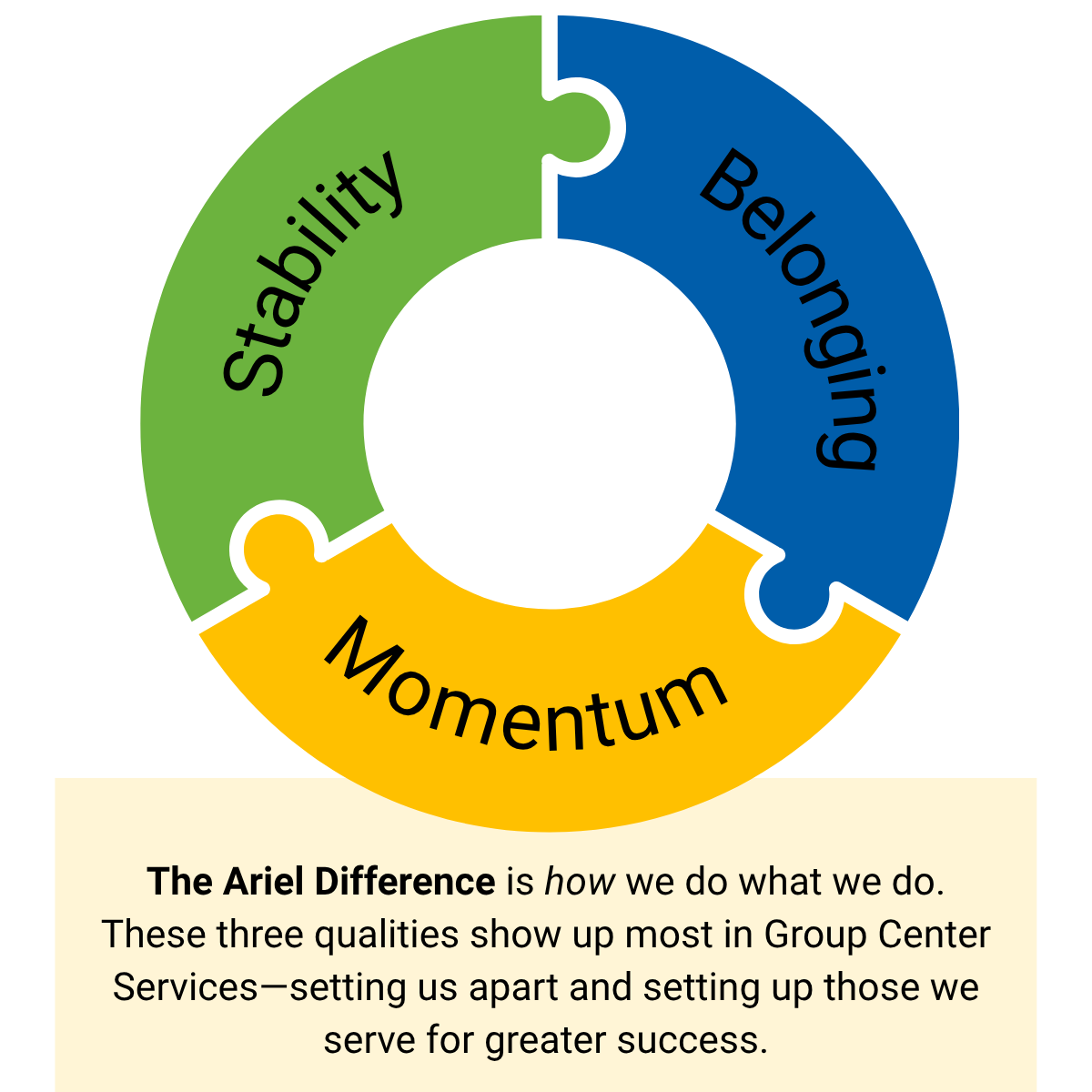
The Ariel Difference: Stability, Belonging, Momentum

Types of Group Centers

Ariel sponsors and supervises group centers across Colorado’s Front Range and Western Slope. Each home is structured to serve a specific population, and placements are made with that specificity in mind.

  • IDD and CHRP-funded homes serve youth with intellectual and/or developmental disabilities (I/DD), including those with co-occurring mental health diagnoses. These homes operate under the Children’s Habilitation Residential Program (CHRP) waiver and are staffed and designed to support the long-term, community-based goals that come with that population: skill development, community integration, and a path forward that may mean reunification with family, readiness for adoption, a step down into foster care, or the skills to live independently.
  • Behavioral health homes serve adolescents and young adults with high behavioral acuity, significant mental health needs, and high-risk histories. These homes are staffed and structured specifically for that level of need, with child-specific treatment modality training for homes working with particular populations.
  • Homes for younger children serve youth ages 7 and up who need a structured, stabilizing environment before returning to a birth family or permanent placement. The goal in these homes is the same as everywhere else on the continuum: get stable, and move toward something more permanent.

Placement decisions account for who already lives in a home. Ariel and the owner-operator review each referral together, looking at whether a placement will work for the young person arriving and for the residents already there.

Additional support available with Group Centers

The support below comes with every Ariel-sponsored group center placement. Some of it reaches residents directly, and some of it reaches the staff who care for them day to day. Ariel’s case management team can explain how any of it works for a specific young person.

Where we provide Group Centers

Ariel sponsors and supervises group centers across Colorado’s Front Range and Western Slope, in the Denver metro area, Colorado Springs, and Grand Junction. What’s open changes as homes fill and new ones come online, so the quickest way to find out what’s available is to call the regional office closest to the young person you’re calling about.

How to get started

Whatever brings you here, the first call is to the Ariel office closest to you.

If you’re making a referral. (Most referrals come from county human services departments and case management agencies, and occasionally from a parent or guardian whose child is already enrolled in the CHRP waiver.) Reach out to the regional office nearest the young person you’re calling about and you’ll get someone who knows what’s open and can talk through whether a home is the right fit. Ariel reviews every referral against who already lives in the home before approving a placement, and confirms the funding source, whether that’s county funding, the CHRP waiver, or another verified source.

If you already run a group center. Owner-operators can change child placement agencies. Ariel takes on billing, funding navigation, licensing compliance, and weekly case management; your license and your business stay yours.

If you’re thinking about opening a group center. Owner-operators arrive at this from all directions: foster parenting, host home work, running a program somewhere else. Ariel provides technical support through the state licensing process, though the license and the business belong to you.

Frequently Asked Questions (FAQs)

If you don’t find what you’re looking for below, feel free to ask your question via our Contact Form.
A foster home is a family setting: usually one person or a couple, parenting day to day in their own home. A group center is staffed around the clock by employees working shifts, and it runs as a program rather than a household, with therapeutic goals written down and progress against them tracked. Colorado regulation caps a specialized group facility at fewer than twelve residents, and Ariel’s homes run smaller than that. For most children and youth, a group center is the step that comes before a foster home, not instead of one.

Colorado regulation uses one umbrella term, specialized group facility, and divides it into two kinds. In a specialized group home, the people running it own the house and live there alongside the children and youth in their care. In a specialized group center, the home is owned or controlled by an organization that hires staff to provide the care, and no one’s family lives on site. Ariel sponsors and supervises specialized group centers.

Children and youth whose needs are higher than a family-based foster home can support: significant behavioral or mental health needs, complex histories, or circumstances that have made previous placements hard to sustain. Some residents qualify for a higher level of care and can’t access it because of demand. Others would otherwise be placed out of state, because nothing closer is available.

Yes. Several homes carry specialized training and programming built for particular populations and treatment needs, and those specialties are a large part of how a placement gets matched. Out of respect for the privacy of the young people living in them, this page doesn’t detail which home serves which population. If you’re considering a referral, tell us what a young person needs and we’ll tell you whether we have a home built for it.

Colorado regulation requires every specialized group center to be sponsored and supervised by a licensed child placement agency. Ariel fills that role: setting standards, training staff, managing billing and funding, coordinating referrals, and checking every week that a home is meeting requirements. Most Ariel-sponsored homes are independently owned and run as their own businesses. Ariel owns and operates one home directly.

Most referrals come from county human services departments or case management agencies. A parent or guardian can also arrange a placement directly when a child is already enrolled in the CHRP waiver. Either way, Ariel reviews the referral before a placement is approved.

Sometimes, though it’s not the usual path. When a child is enrolled in the CHRP waiver, a parent or guardian can arrange a placement without county involvement, because waiver eligibility rests on level of care and disability rather than custody status. If your child isn’t enrolled yet, that starts with your local case management agency rather than with Ariel, and they can tell you whether your child qualifies. Most placements still come through a county or a case management agency, so if you’re early in figuring this out, your case manager is the person to ask first.

Every referral is reviewed against who already lives in the home. The question isn’t only whether a bed is open—it’s whether this home is the right environment for this young person, and whether the placement will work for the residents already there. Ariel and the home’s owner-operator make that decision together.

Placements are funded through county human services or the CHRP waiver, and more than one source can apply to a single placement. Ariel handles the funding and billing side so it doesn’t slow down a referral.

Long enough to stabilize, and no longer than that. For many residents it’s a matter of months before stepping down to a foster home or returning to family. For young people building daily-living skills through the CHRP waiver, it can be considerably longer, because that kind of progress doesn’t happen on a short timeline. Either way, the measure is a young person’s own goals rather than a calendar, and the direction is always toward a less restrictive setting.

Every week. An Ariel case manager assigned to the home visits on site, spends time with residents, reviews employee files and incident reports, and verifies that safety and staffing requirements are being met. If something looks out of compliance, Ariel can also visit unannounced.

Yes. Therapy comes from Medicaid-covered providers in the community, and Ariel makes the referral through relationships already in place rather than starting from scratch.

Group center staff are trained to handle day-to-day crises on site, and most situations are resolved there. Ariel is reachable after hours for direction and reporting, and any critical incident has to be reported to Ariel right away.

Youth aging out of foster care can continue receiving support through the Foster Youth in Transition (FYT) program, which helps with housing, employment, and education. Residents who enroll in a vocational program or college also continue receiving support from Ariel while they’re in school.

No. Policy changes altered how congregate care is funded, which reduced how many programs operate, but the need didn’t go away. Ariel is one of a small number of child placement agencies in Colorado still sponsoring specialized group centers.

Reach out to the Ariel regional office closest to you. Group centers are owned and run by owner-operators, and Ariel provides technical support through the state licensing process. Whether you’re starting from scratch or moving an existing home from another agency, that conversation is the place to begin.

>> Unless otherwise noted, all images and names represent real people but actual images and names have not been used for privacy reasons. <<