What is foster care?
Foster care provides temporary, safe homes for children and youth who can’t remain with their birth families due to abuse, neglect, or a family crisis. In Colorado, counties hold legal custody of children in out-of-home placement and partner with private child placement agencies like Ariel to find and support appropriate homes. Children and youth in care range from newborns to young adults (up to age 21 for those with developmental disabilities), come from all backgrounds, and may have a wide range of needs. Some placements last days; others last months or years. The goal in every case is reunification—returning children home safely when that’s possible.
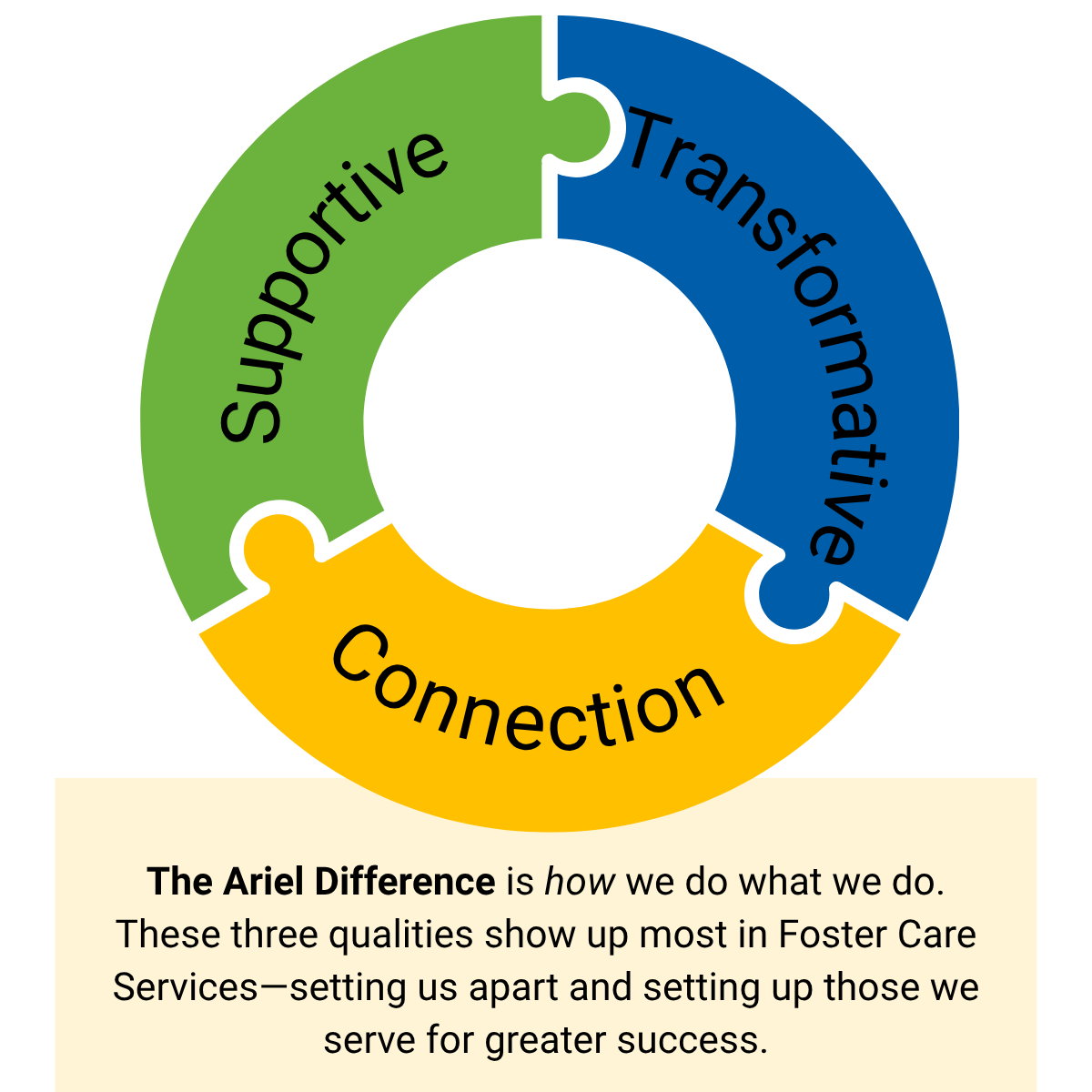
The Ariel Difference
When a foster parent calls at 9:30 at night, someone answers. When one family suddenly took on two new placements and needed a hand with the school-age child already in the home, a team member stepped in. How much help each family gets depends on what that family needs: a monthly in-home visit at minimum, plus text check-ins, coffee shop conversations, IEP meetings, even soccer field meetings. The clinical team is on call around the clock, for everything from a behavioral crisis to a question that can’t wait until Monday.
Ariel’s approach to the children in those homes starts with a reframe: a child’s behavior is a window into what they’ve been through. So foster parents get context alongside guidance. A child who fights about dinner every night may once have gone without knowing food would be there. A child who won’t settle at bedtime may be carrying something from a time when nights weren’t safe. Ariel believes every child can heal, and that healing grows out of steady routines and trusted relationships. That belief shapes how the team works together, too. Where Ariel offers therapy, therapists work down the hall from case managers and family time staff, so they can talk through what a child needs as it comes up and keep anything from slipping between departments.


Types of Foster Care
Traditional, Therapeutic, Treatment, and Proctor are license classifications for foster parents. Each one describes the training, experience, and coordination a foster parent has in place, and none of them is a label for a child. A child in foster care is just in foster care, getting the support they need.
License levels
- Traditional | The starting point for most families. Traditional licensing involves the standard training hours, a home study that explores what situations and age ranges the family is ready for, and Ariel’s full case management support from day one. Every placement involves trauma, traditional ones included, and Ariel treats each one that way.
- Therapeutic | Therapeutic licensing involves additional training and more frequent contact with the treatment team. Families at this level work with children and youth who have significant trauma responses, medical needs, or behavioral challenges. At times, that calls for more intensive therapeutic services, coordinated across the family, the foster home, and the treatment team.
- Treatment | The highest level, and relatively rare. Treatment foster care requires significantly more training hours, specific ongoing education, and intensive coordination with therapists, case managers, and medical providers. Most families who reach this level have come up through the therapeutic level over time, or arrive from another agency already experienced. Ariel has just a few of these foster homes, which reflects how much this level asks of a family.
- Proctor care | Proctor care runs through the judicial system, separate from child welfare. Proctor homes partner with the Division of Youth Services (DYS) to support youth who are preparing to transition to parole. The focus is on what comes next: employment, continued education, mental health support, and the routines that make independence real. Compensation is higher, reflecting the nature of the work.
Other kinds of care
- Certified kinship care | When a child is removed from their home and a family member is available to step in, kinship placement is often the best way to keep that child close to people they know. Ariel works only with certified kinship families; the county manages uncertified kin placements directly. Getting certified means Ariel can provide the same case management, training, and team support available to all Ariel foster families. If this describes your situation, reach out and we’ll walk you through what the process looks like.
- CHRP foster homes (Children’s Habilitation Residential Program) | CHRP is a Medicaid waiver program for children and youth ages 0–21 with intellectual and developmental disabilities (I/DD). As an approved CHRP provider, Ariel supports certified foster families in helping children and youth thrive in their homes and communities. Services available through the waiver include habilitation support, respite care, therapy, and community integration—all aimed at building self-help, socialization, and adaptive skills while reducing the risk of out-of-home placement. Child welfare isn’t always involved; sometimes a family simply reaches a point where they need more support than they can manage on their own. Ariel is actively building its network of CHRP-certified homes, particularly reaching out to families with I/DD experience.
- Group centers | Some children and youth need a more structured environment than a family-based home can provide. Ariel sponsors and supervises specialized group facilities, known as group centers, for adolescents and youth with higher-level needs who require this level of care.
Some foster families go on to adopt when a child can’t safely return home. Learn about adoption at Ariel.
Additional support available with Foster Care
Most of the services below require county referral and approval for each child, so what’s available depends on the placement. Your case manager can help clarify what applies to your situation.
Where we provide Foster Care
Ariel provides foster care across Colorado through five regional headquarters (HQs), and most of the options on this page are available at every location. What each HQ can offer at a given time depends on local capacity and the licensed families available nearby. Today, Ariel’s foster families care for children and youth in more than a third of Colorado’s 64 counties. For the most up-to-date options in your area, contact your regional HQ.
How to get started
People come to foster care from different directions. Most children and youth are placed by the county, whose caseworker reaches out to Ariel to find the right home. Some families are relatives or close family friends who step in when a child is removed, and becoming certified for kinship care means Ariel can support them like any other foster family. Others are thinking about becoming foster parents for the first time. If that’s you, the path from first conversation to license is laid out step by step on our Become a Foster Parent page.
If you’re a county caseworker or professional, contact Ariel directly to discuss placement needs, service availability, or specifics about a child or family. You can find your closest regional HQ here.
Frequently Asked Questions (FAQs)
If you don’t find what you’re looking for below, feel free to ask your question via our Contact Form.
Questions about Foster Care
Questions about Becoming a Foster Parent
For the full process, from first conversation to license, visit the Become a Foster Parent page.
>> Stories on this site are about real people. To protect their privacy, names, details, and images may have been changed. <<